Addition Word Problems Worksheets
Help students connect concrete situations to addition equations. These worksheets cover joining actions, additive comparisons, and part-part-whole schemas with spacious student working boxes for sketches and tape diagrams.
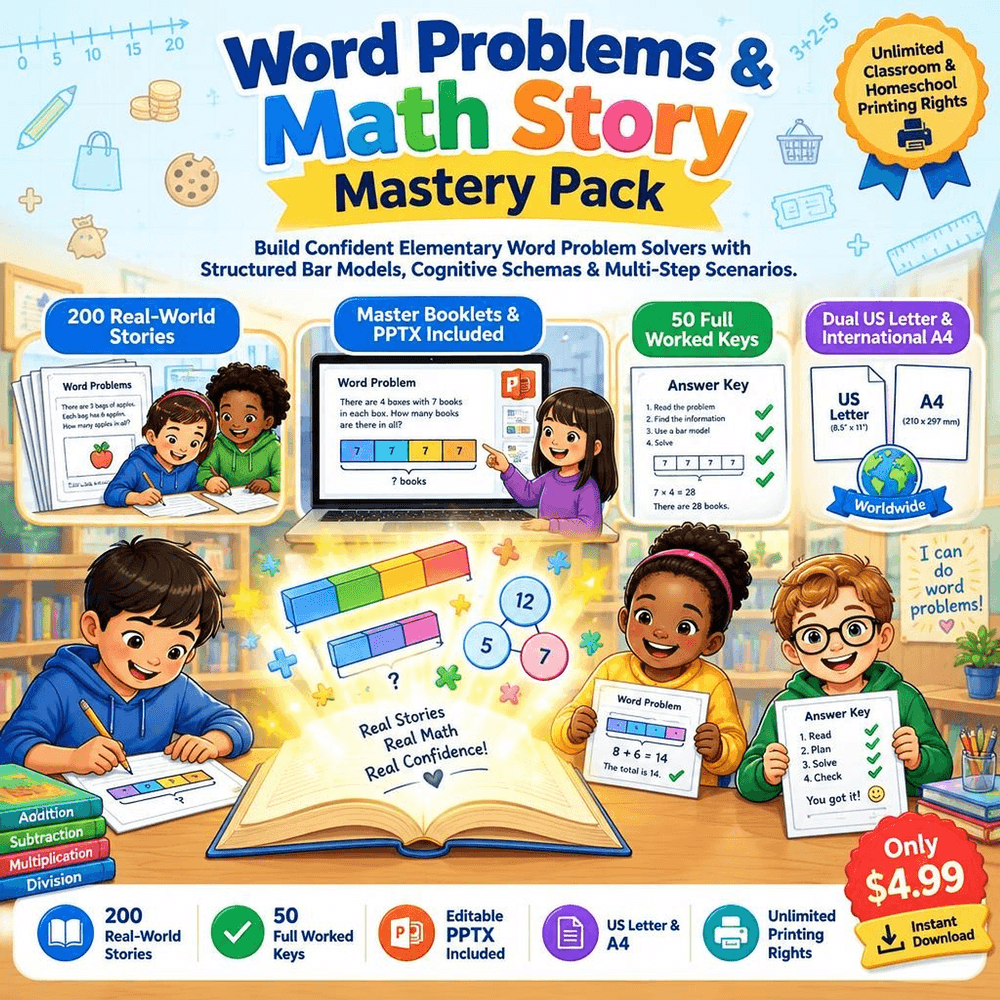 Cover$4.99
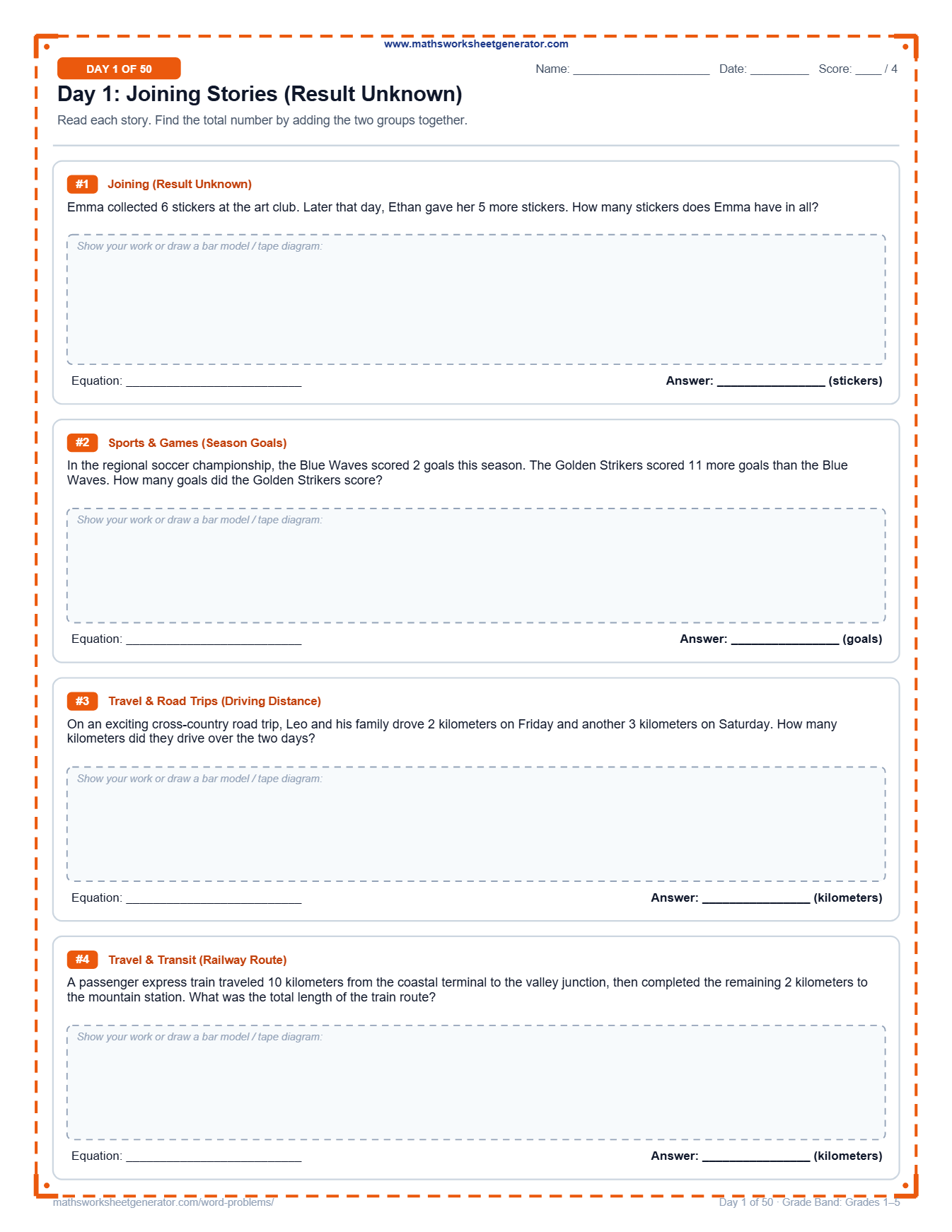 Student Sheet$4.99
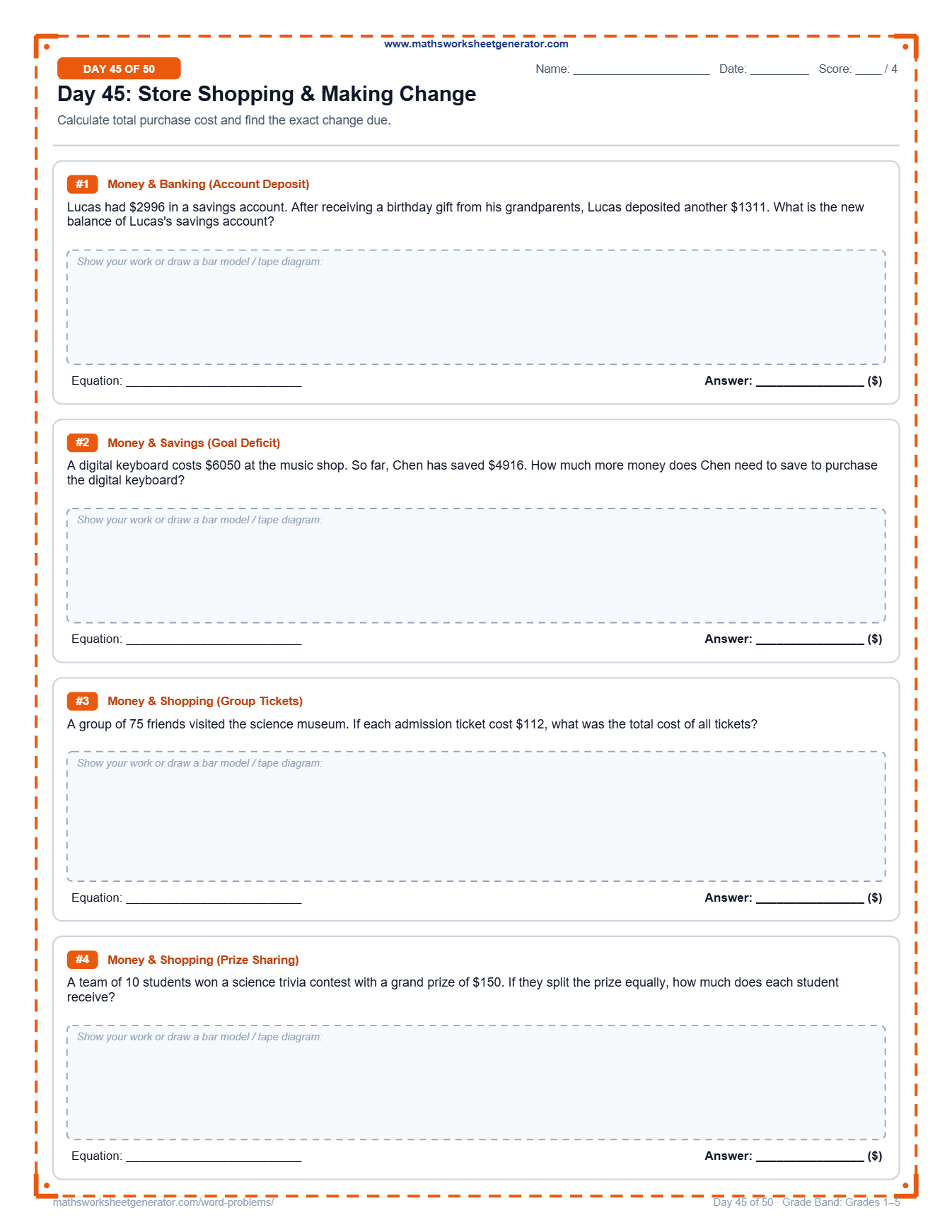 Advanced Unit$4.99
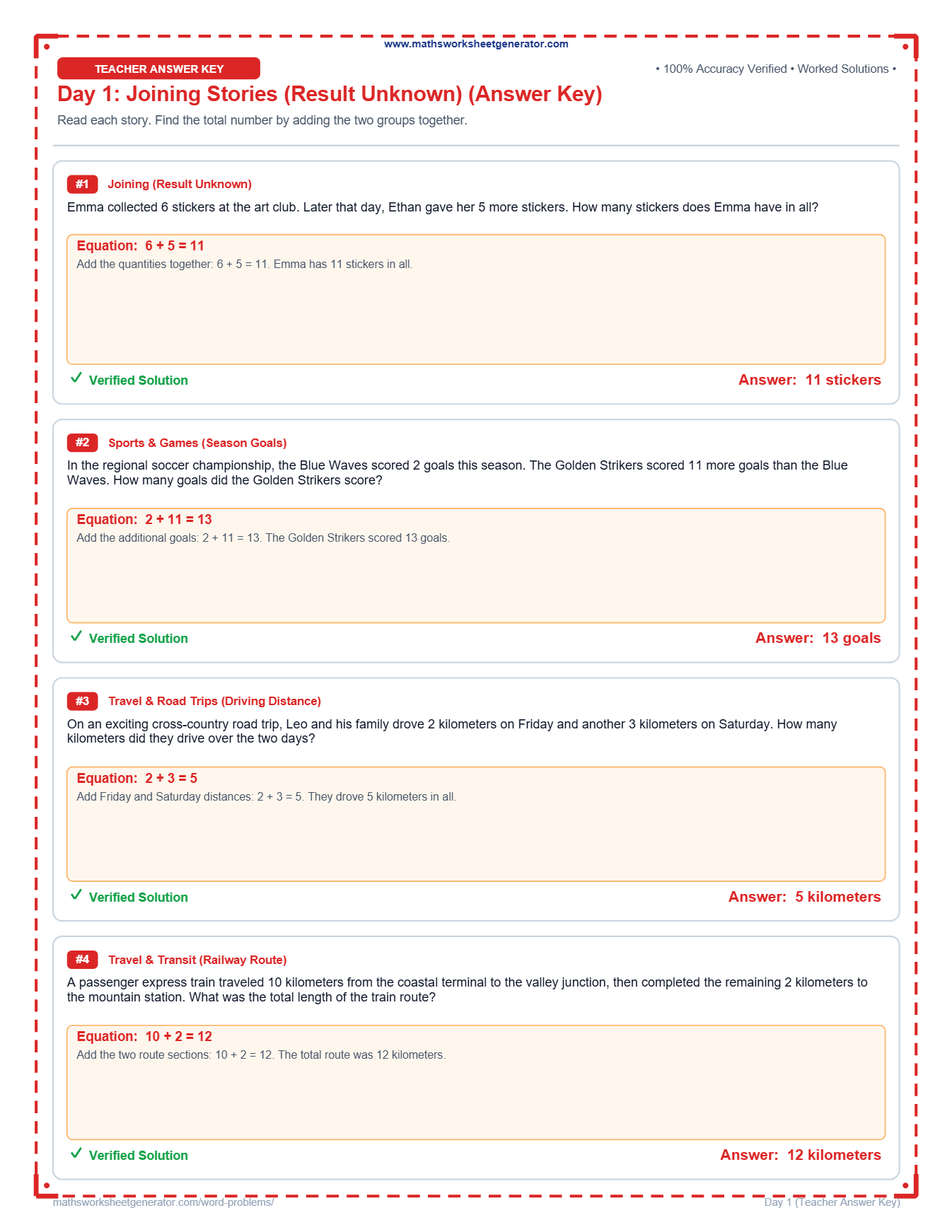 Full Solutions$4.99
Choose Arithmetic Operation
Select a single focus operation or mixed practice for spiral review.
Target Cognitive Schema
Common Core mathematical structures for conceptual problem-solving.
Difficulty & Numerical Scope
Calibrate numbers to match your grade level expectations.
Story Setting & Vocabulary
Engage students with diverse, relatable everyday scenarios.
Global Localization & Units
Choose your local currency and measurement units for real-world story problems.
Problem Layout Format
Choose full-width single column (best for tape diagrams) or 2-column grid.
Problems Per Worksheet
Control the amount of workspace provided for student handwritten work.
Title & Page Options
Generated fresh in your browser. Vector rendering ensures crisp printing.
Instant Sheet Preview
📄 Real-time High-DPI Preview.
About this worksheet
Addition word problems help students recognize that addition is more than just combining numerals—it represents dynamic real-world actions. In early elementary math, addition situations fall into three primary cognitive categories: Joining (Result, Change, or Start Unknown), Part-Part-Whole, and Additive Comparison.
Visual Modeling: Each problem includes a generous student workspace designed for bar models (tape diagrams) or number lines. Drawing a bar model helps students identify whether they know the parts and need to find the total, or if they need to add an additional quantity to an existing set.
Teaching Tip: Encourage students to write the full equation (e.g. 24 + 18 = 42) and state their final answer with complete units (e.g. '42 pencils') to foster clarity and algebraic reasoning.
A Research-Backed Word Problems Generator built for conceptual math mastery
Solving word problems is one of the most challenging areas in elementary mathematics education. Research shows that students who memorize "keywords" (like assuming "more" always means addition) struggle when facing complex real-world situations. This free online generator is designed around Common Core Cognitive Problem Schemas to build deep algebraic and structural comprehension.
Whether practicing Joining & Separating (Change Unknown, Start Unknown), Additive & Multiplicative Comparison, Part-Part-Whole, Equal Groups & Arrays, or Partitive & Quotitive Division, every worksheet provides ample student working boxes to encourage visual modeling (bar models / tape diagrams) and written justification.
Download your custom worksheets instantly as clean, vector-rendered PDFs or fully editable PowerPoint (.pptx) slide decks formatted for classroom smartboards and printable paper packets.
Common Core Mathematical Schemas Covered
Joining & Separating
Dynamic change scenarios where quantities increase or decrease over time, with Result, Change, or Start values unknown.
Comparison Schemas
Comparing two distinct sets to find the difference, greater unknown quantity, or lesser unknown quantity.
Equal Groups & Arrays
Repeated addition, rows and columns, area modeling, and unit rate pricing for multiplicative thinking.
Fair Sharing & Measurement
Partitive division (equal sharing among friends/teams) vs quotitive division (packing into set capacities).
How to use this generator in your classroom
1. Choose your operation & structure. Select Addition, Subtraction, Multiplication, Division, or Mixed Operations. Focus on all structures or isolate specific schemas.
2. Set the grade level. Select from Grade 1–2 (within 20), Grade 2–3 (within 100), Grade 3–4 (within 1,000), Grade 4–5 (multi-digit), or enter custom bounds.
3. Select workspace density. Choose 4 problems for extra large student working boxes, 6 for standard practice, or 8 for compact review.
4. Generate & print. Click 'Generate & Download PDF' for classroom-ready printables or 'Download as PPTX' to present interactively on your interactive whiteboard.