Geometry & 2D/3D Shapes Foundation Mastery
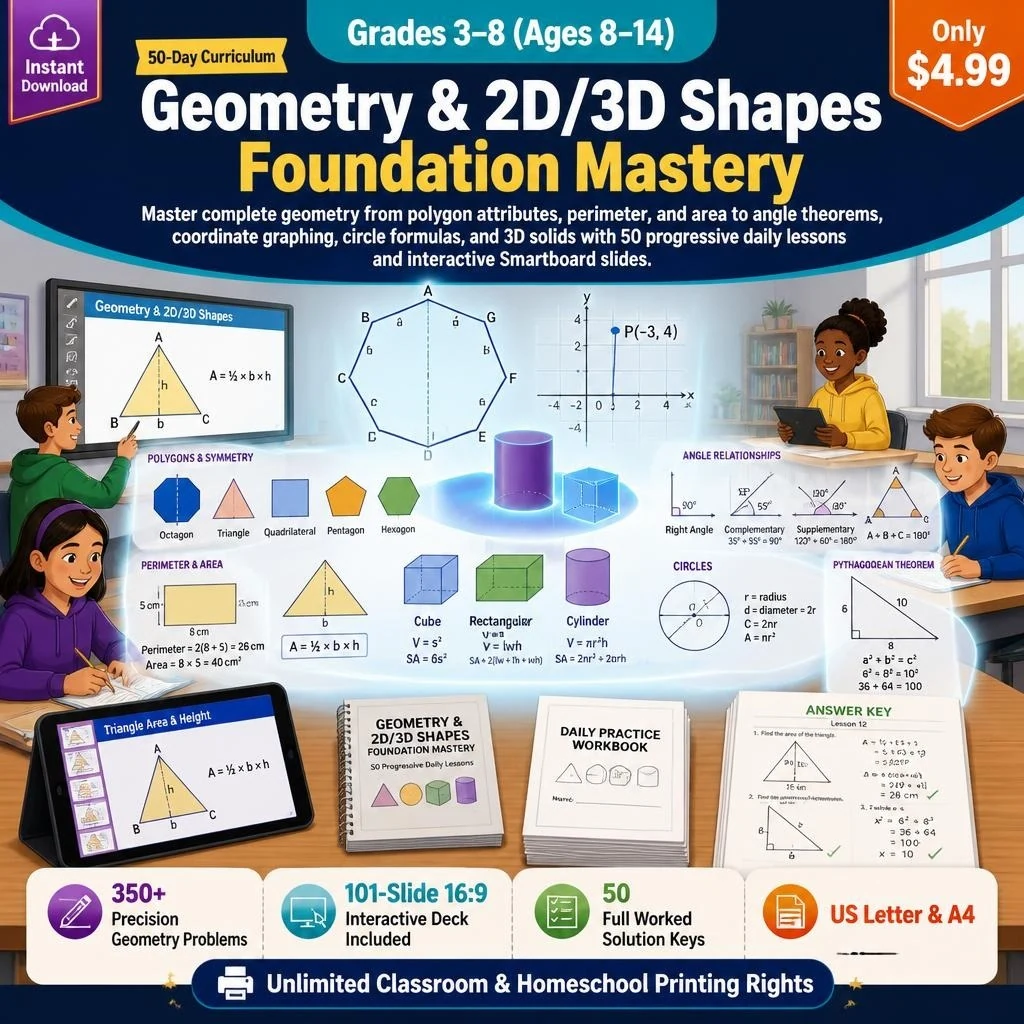
Master complete geometry from polygon attributes, perimeter, and area to angle theorems, coordinate graphing, circle formulas, and 3D solids with 50 progressive daily lessons and interactive Smartboard slides.
Structured Day-by-Day Learning Progression
Carefully calibrated module sequencing designed to take students from initial place-value concrete models to rapid computation automaticity without cognitive burnout.
| Day Range | Core Module & Skill | Pedagogical Focus & Sample Problem | Learning Objective |
|---|---|---|---|
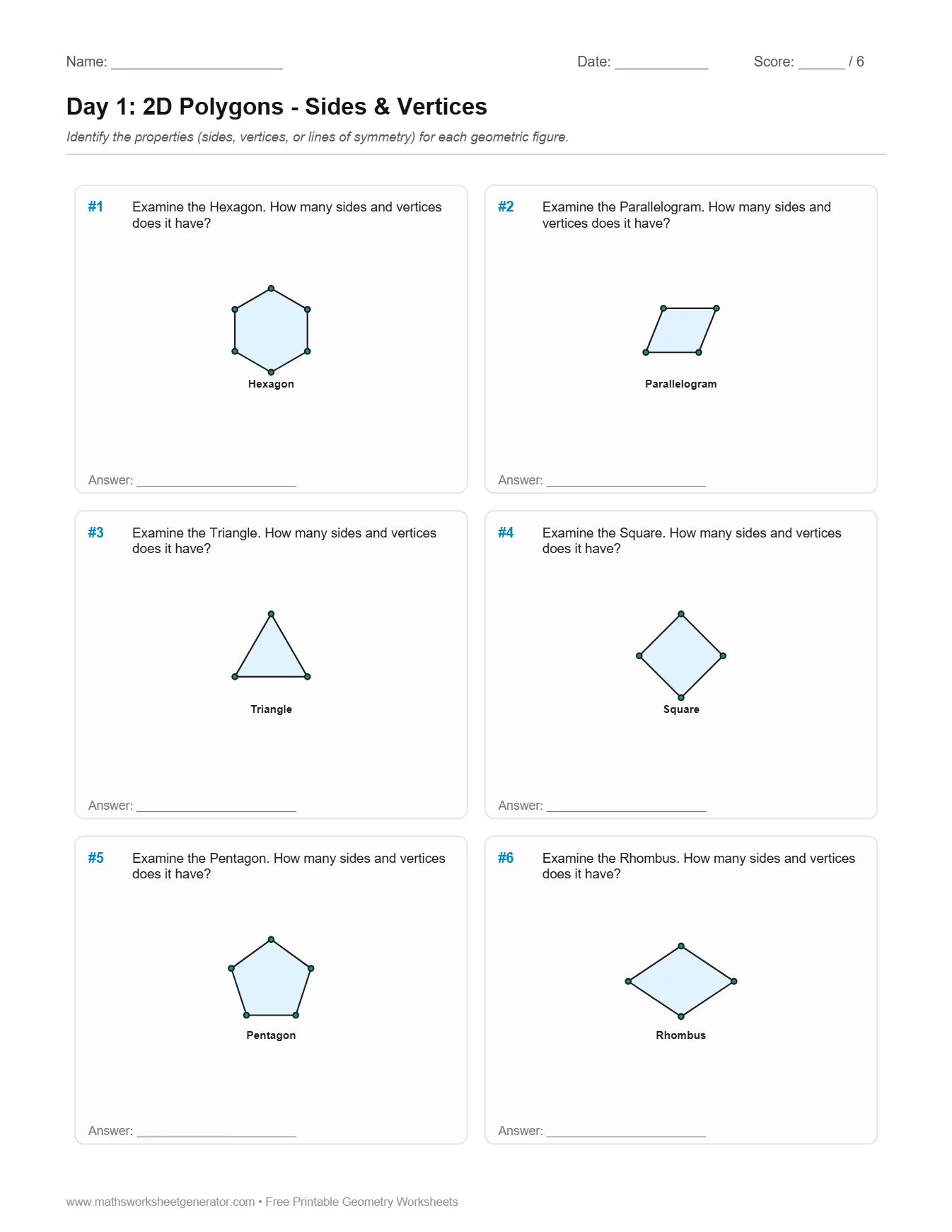
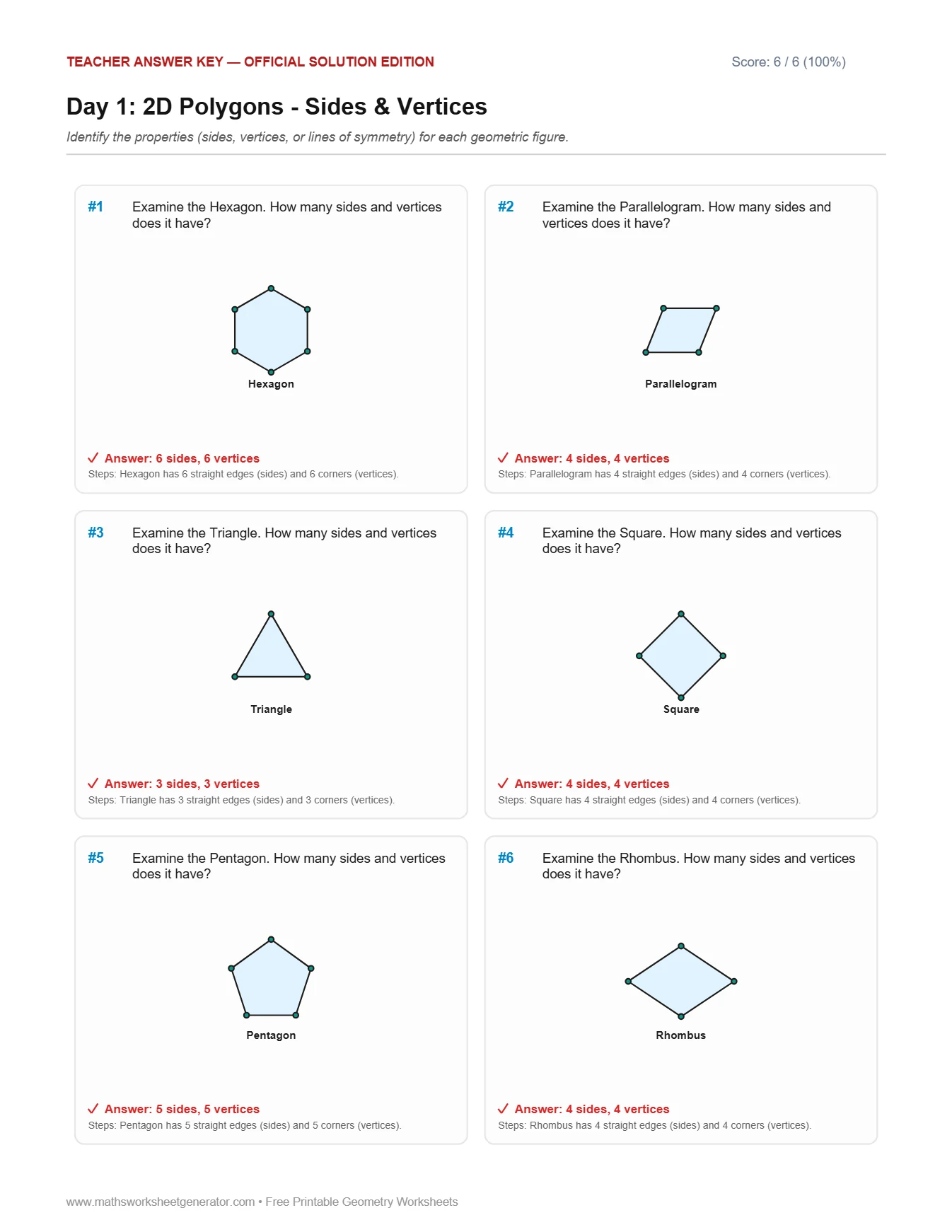
| Days 1–8 | 2D Shapes, Attributes & Symmetry (Grades 3–5) | Octagon: 8 sides, 8 vertices, 8 lines of symmetryIdentifying 13 regular and irregular polygons (triangles, special quadrilaterals, pentagons to dodecagons), counting sides and vertices, and drawing reflection axes of symmetry. | Builds spatial recognition, polygon nomenclature, and geometric reflection concepts before formal calculation. |
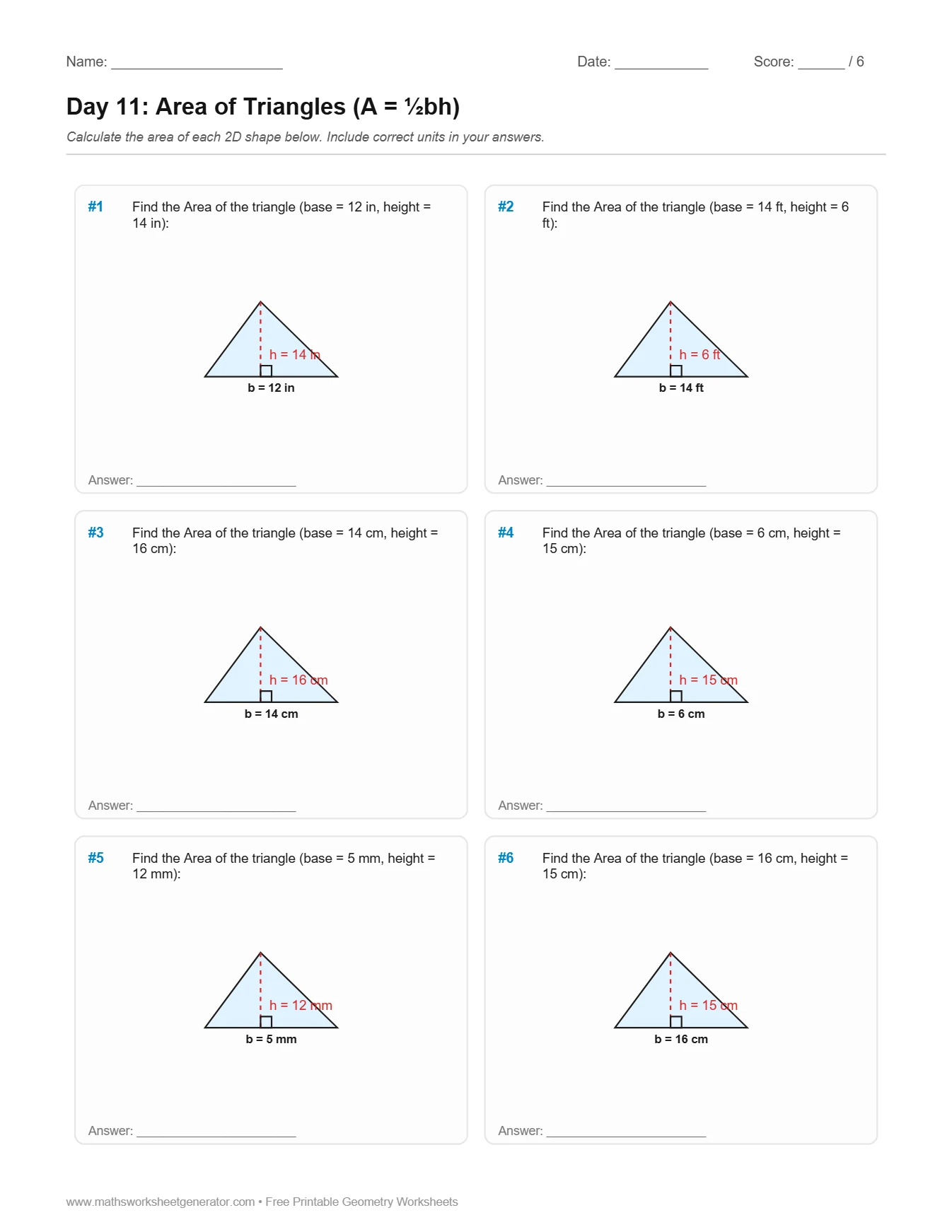
| Days 9–16 | Perimeter & Area of 2D Polygons (Grades 3–6) | Triangle: A = ½ · b · h = ½ · 12 · 8 = 48 cm²Perimeter and area of rectangles, squares, triangles (with altitude h), parallelograms, and trapezoids in metric and customary units. | Differentiates linear boundary distance (perimeter) from 2D square unit coverage (area) across all major polygons. |
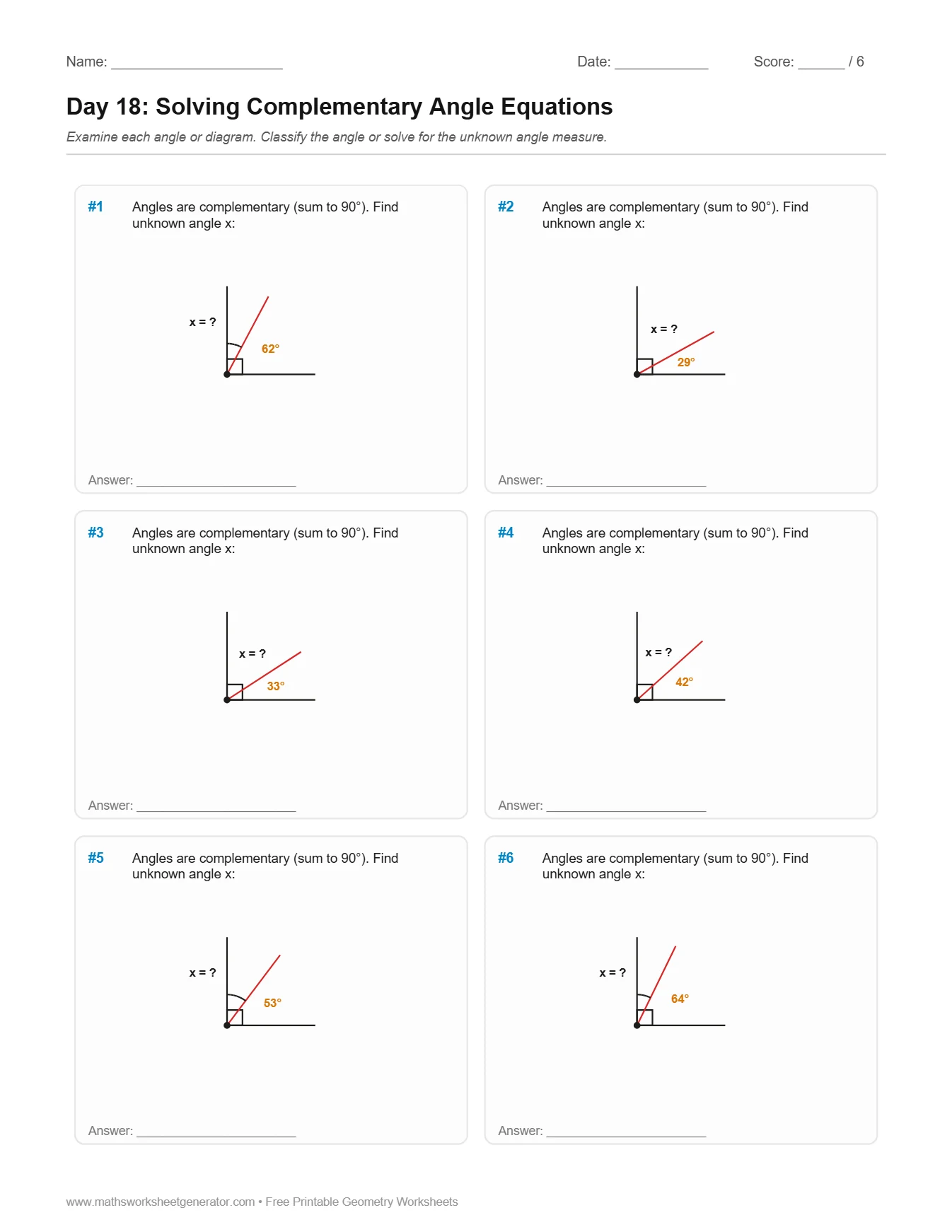
| Days 17–24 | Angle Relationships & Triangles (Grades 4–7) | Complementary: x + 38° = 90° → x = 52°Classifying angles, complementary (90°), supplementary (180°), vertical angles, and the Triangle Angle Sum Theorem (∠A + ∠B + ∠C = 180°). | Trains algebraic equation setup from visual geometric angle relationships, laying pre-algebra foundations. |
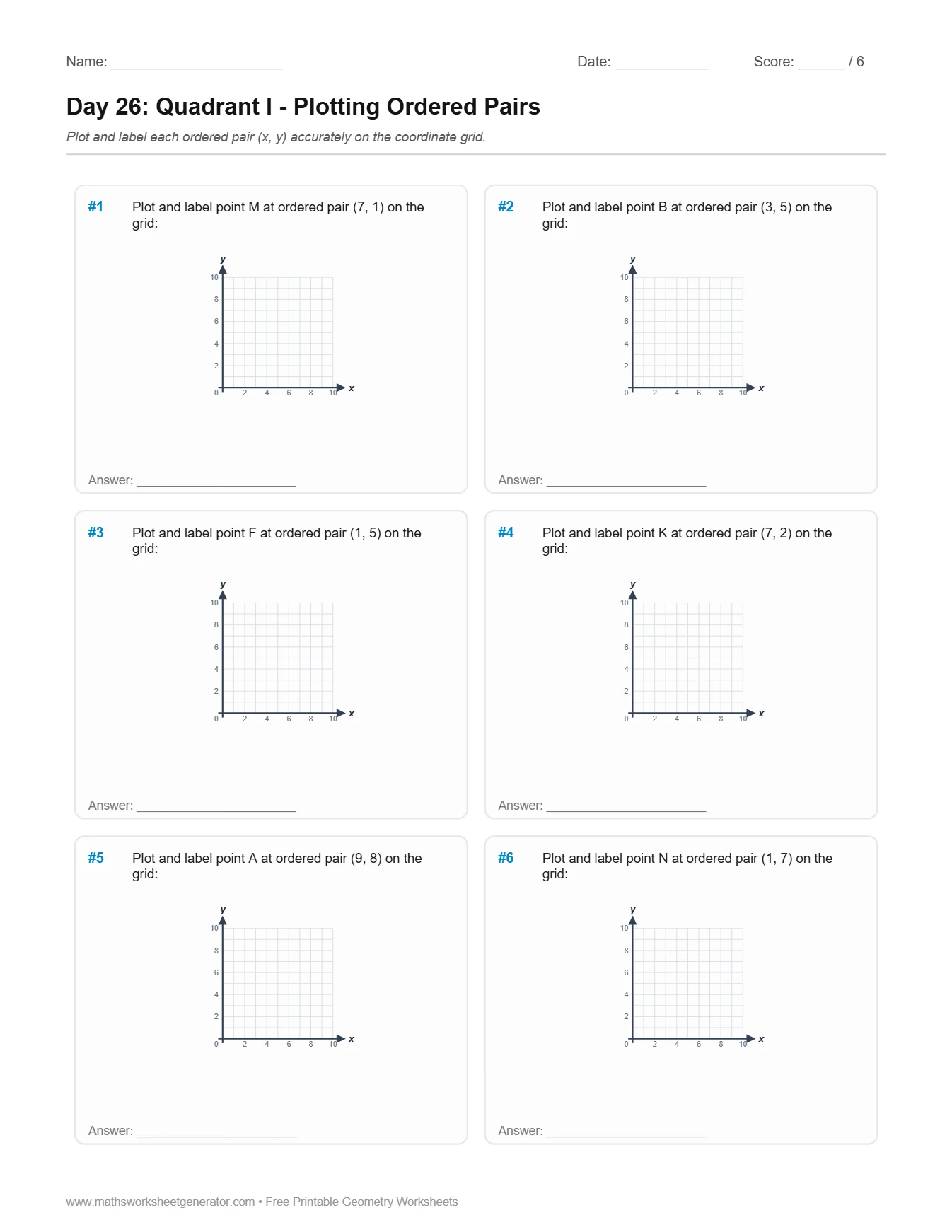
| Days 25–32 | Coordinate Plane Graphing (Grades 4–7) | Plot point P(-3, 4) in Quadrant IIReading coordinates, plotting ordered pairs (x, y) on Quadrant 1 grids, transitioning to 4-quadrant planes, and graphing geometric vertices. | Connects 2D geometry to Cartesian coordinate navigation and prepares students for linear equations. |
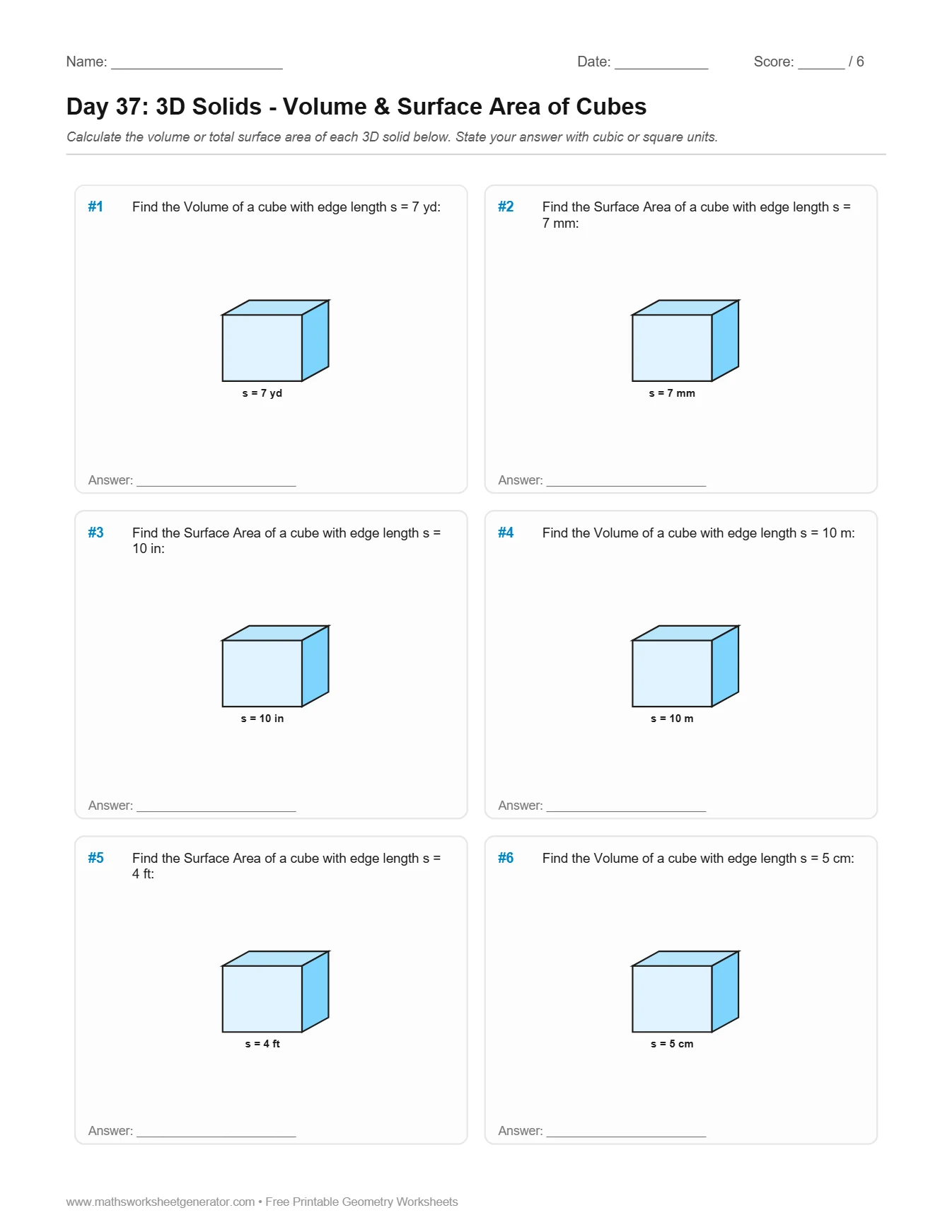
| Days 33–41 | Circles & 3D Spatial Geometry (Grades 6–8) | Cylinder: V = πr²h = 3.14 · 4² · 10 = 502.4 cm³Radius vs diameter, circumference (C = 2πr) and area (A = πr²) with π ≈ 3.14 and 22/7; volume and surface area of prisms, cubes, and cylinders. | Bridges planar circles to 3D spatial solids, visualizing 3D isometric nets and circular bases. |
| Days 42–50 | Pythagorean Theorem & Capstone (Grades 7–8) | a² + b² = c² → 6² + 8² = c² → c = 10Finding hypotenuse c and missing legs a or b using integer Pythagorean triples (3-4-5, 5-12-13, 8-15-17), composite shapes, error analysis, and final capstone exam. | Synthesizes multi-step geometric problem solving, radical square roots, and rigorous high-school geometry preparation. |
Educational Standards Alignment
This mastery pack directly addresses key Common Core State Standards (CCSS) for mathematics:
Relate area to the operations of multiplication and addition, and solve real-world mathematical problems.
Draw points, lines, line segments, rays, angles (right, acute, obtuse), and perpendicular and parallel lines.
Recognize a line of symmetry for a two-dimensional figure as a line across the figure such that the figure can be folded along the line into matching parts.
Use a pair of perpendicular number lines, called axes, to define a coordinate system, with the intersection of the lines (the origin) arranged to coincide with the 0 on each line.
Find the area of right triangles, other triangles, special quadrilaterals, and polygons by composing into rectangles or decomposing into triangles.
Know the formulas for the area and circumference of a circle and use them to solve problems; give an informal derivation of the relationship between the circumference and area.
Apply the Pythagorean Theorem to determine unknown side lengths in right triangles in real-world and mathematical problems in two and three dimensions.
4 Ways to Use This Pack in Your Classroom or Home
Smartboard Interactive Warmup
Project the 16:9 widescreen slide on your interactive board for a quick whole-class angle or shape identification sprint.
Geometric Construction Lab
Students measure, sketch, and verify polygon perimeters, altitudes, and symmetry axes on the daily worksheet.
Coordinate Grid Battleship
Timed partner challenge plotting and identifying coordinates and geometric vertices on 4-quadrant grids.
Formula Error Detective
Students analyze common geometry traps (e.g., forgetting to divide triangle area by 2 or squaring diameter instead of radius) and correct the math.
Pack Technical Specifications
Frequently Asked Questions
What topics and grade levels are covered in this 50-day geometry bundle?
Are interactive PowerPoint slides included for classroom smartboards?
Does this pack include both Metric and Customary units?
Are worked solution keys included for all 50 days?
Can I print copies for my entire school or class?
More Math Mastery Packs You Might Like